


OUR EMBLEMS
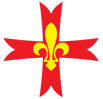
The emblem of our movement is "argent an eight-pointed cross gules, overlaid with a golden fleur-de-lis". It was chosen by the founders of the movement in Cologne in 1956.
The red Maltese Cross recalls the ideal of former knighthood, in particular, that of the Order of St John of Jerusalem, red being the colour of generosity and courage. The eight points also recall the religion of our movement's members, and the red, the blood of martyrs. The eight points illustrated, for the former Knights of Malta, the eight virtues of the Beatitudes of the Sermon on the Mount that they were to acquire.
The fleur-de-lis is the explorers universal emblem, recalling the fleur-de-lis pointing North on former maps – and thus in the right direction-, and its points illustrate the three main virtues of explorers, i.e., truthfulness, devotedness and pureness.
The emblem of the movement is worn on the beret or four dented hat, the chest, the belt buckle, and the movement's flag, called the Baussant.
OUR BAUSSANT
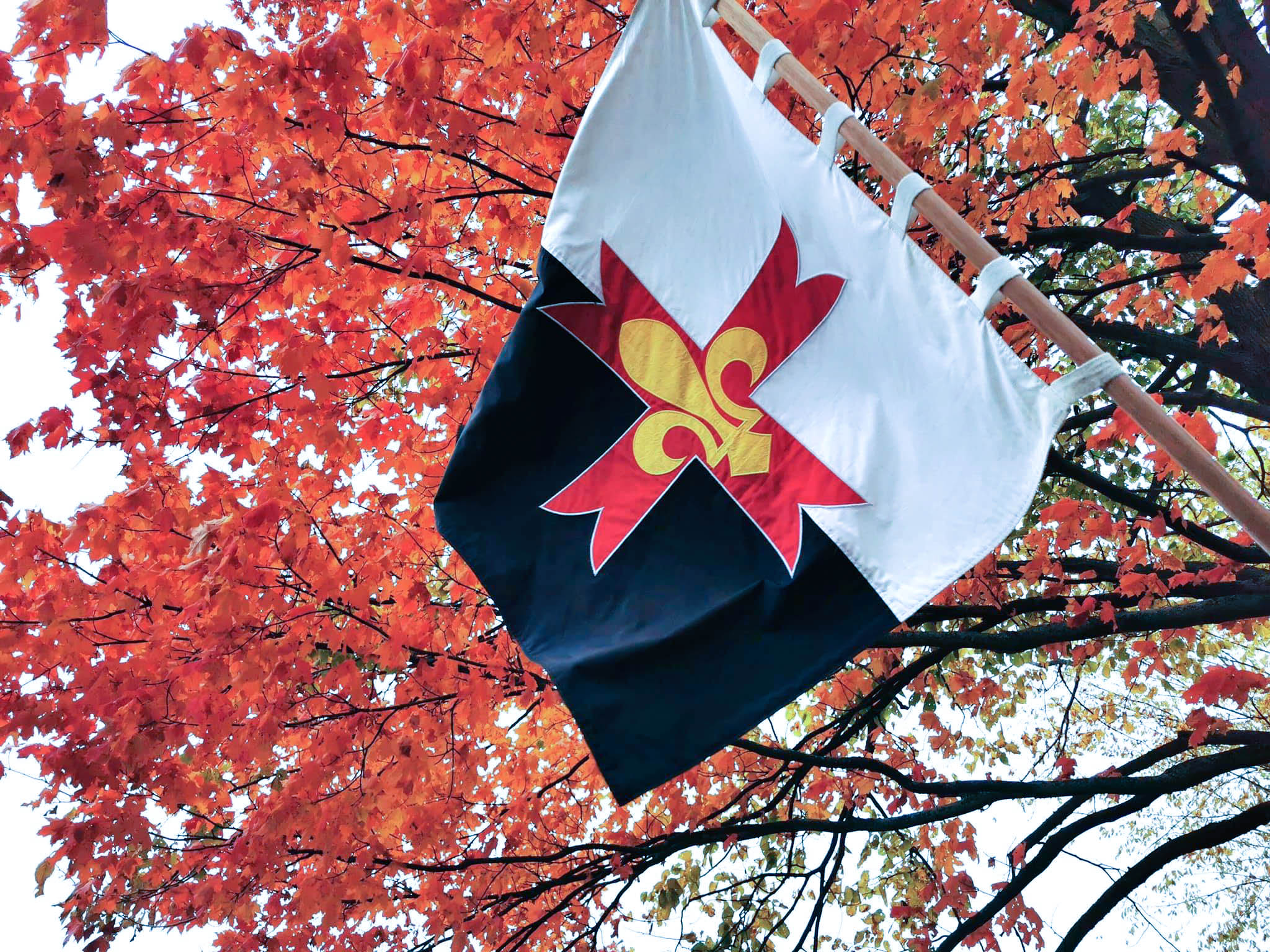
The Baussant is the flag of the Guides and Scouts of Europe and the Federation of North American Explorers. The word "Baussant" comes from old French meaning "beau signe" or "beautiful sign". This banner was created and adopted in 1966 during the movement's pilgrimage to celebrate the millennium of - Mont St. Michael.
It is directly inspired by the Templar banner and has a two-tone background, black on the left and white on the right. As on the Templar gonfanon, where they are superimposed, these colours illustrate the fight of good against evil. On this background is the emblem of the movement, i.e., the red Maltese Cross with a golden fleur-de-lis. Our FNE Explorers and their leaders commit solemnly on this Baussant when they make their Promise.
The white part of the Baussant represents the "banner of Christ", Heaven, and the works of the Holy Spirit. The black part recalls the earth and our daily commitment to act practically and to fight evil.
White and black are two colours that have always depicted light and darkness, and therefore also symbolise the fight of good against evil which takes place in the world and in the life of each one of us.
In the centre, the eight-pointed Cross with the fleur-de-lis reminds us that the victory of light over darkness started with the sacrifice of Christ on the Cross.
The Baussant pictures our will as FNE Explorers to help establish the reign of Christ in our lives and in the world around us.
UNIFORM
The purpose of the uniform is to form a single and united group, showing no difference in clothing styles that would indicate the origin or social level. A visual expression of the whole pedagogy, the wearing of the explorer uniform is also a sign showing the Union’s unity wherever there are groups of FNE Explorers.
- The uniform consists of navy-blue shorts or skirt with navy blue knee socks, and beige, navy-blue, or light-blue shirts, according to the age group, gender and eventually the activity field (e.g. mountain or sea explorers).
- All wear a leather belt with the explorer cross on the buckle, a symbol of exploring adventure, reminding them that “to put on a belt is to freely accept discipline and, to be ready to go“.
- On the shirt are sewn badges which show the explorers various development stages such as classes, badges, proficiency badges etc. They also encourage the younger explorers to learn from their elders and thus grow. Other insignia are there to show their FNE membership, but also that they belong to their country, region, group and patrol (bands).
- Explorers and adult leaders wear a four-dented hat, a beret for the Timber Wolves, and a bucket hat for the Otters.
- The scarf is the universal explorer trademark. It can be used just as well for games as for first aid bandages. Each FNE group has its own colour combination reflecting a spiritual meaning and a non-spiritual meaning.